
 The stock market has enjoyed an incredible rally in the final months of 2019. It was pretty much the exact opposite of the way stocks performed in late-2018. A year ago, stocks were finishing a rough December, and that came after a not-so-good October and November. Stocks had fallen steeply with the worst negative momentum in years. A year ago, in late-December, I published what I hoped were calming words in my assessment of the then current conditions. This was my assessment a year ago, warts and all:
- The worst is probably over.
- The odds of at least one lower low are still pretty strong, but that low will probably not be worse than another 4 to 6% lower.
- Volatility is likely at or very near a peak. Expect volatility to gradually subside to more traditional levels into late-January and February.
- Many stocks seem to already have declined to bargain prices, but the current negative momentum suggests that there’s no rush to buy.
- Economic conditions are pretty good, but growth is slowing.
- The Fed and its Chairman Powell are being blamed for a lot of market reaction in which other factors are much more significant catalysts.
- Corporate profits are strong, but their rate of growth is probably also slowing.
- To me the biggest wild-card going forward is not the Fed, not trade talks, not the budget ceiling/shutdown, but the junk bond and leveraged loan credit markets. The markets have been selling-off steeply even as the Treasury market rallied. If that trend continues, it would be a bad omen for the stock market.
- Where the recent detours (mentioned above) were followed by new highs in five or six months, I’m guessing it’ll take longer this time.
- As the market works to find a low and form a bottom, keep in mind that it may be creating perhaps the best buying opportunity in several years and for several more to come.
- The best is probably over, at least for a little while. The stock market’s big rally in late-2019 pushed it into a statistically over-bought condition from which it is unlikely to see significant additional appreciation in the next several months.
- This could be a good time to rebalance portfolios. The strong stock market gains last year probably caused portfolios to become over-weighted in equities in general and U.S. equities in particular.
- The good news is already priced in. The market will need more and better news to continue higher but is more likely to be disappointed by news, especially on the trade talks.
- The Fed is out of good news. The repos could continue but any significant policy change will likely be bad news or in reaction to other bad news.
- Without bad news, I have no reason to expect a bad year. Many analysts expect the market to be making new highs later in the year as the election comes into focus.
- Without bad news, any technical, short-term danger signal in the market seems very unlikely in the early part of 2020. Upward momentum is strong and will take some time to dissipate. SPX, which is finishing the year a bit above 3200, would need to fall to near the 3000 level before any technical alarms would be triggered.
- The best bet seems to be for SPX to spend the first quarter of the year in the 3100 – 3300 range.
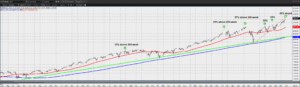 Chart courtesy Pershing MarketQ and Interactive Data Corp.
Please note that rebalancing investments may cause investors to incur transaction costs and, when rebalancing a non-retirement account, taxable events will be created that may increase your tax liability. Rebalancing a portfolio cannot assure a profit or protect against loss in any given market environment.
Links to previously published commentaries can be found at benjaminfedwards.com/For Our Clients/Educational Resources/Market.
Chart courtesy Pershing MarketQ and Interactive Data Corp.
Please note that rebalancing investments may cause investors to incur transaction costs and, when rebalancing a non-retirement account, taxable events will be created that may increase your tax liability. Rebalancing a portfolio cannot assure a profit or protect against loss in any given market environment.
Links to previously published commentaries can be found at benjaminfedwards.com/For Our Clients/Educational Resources/Market.