
Perhaps you have already created some type of trust to address these concerns. Did you know there are also tax management and creditor protection reasons to create such trusts, and that you can stipulate that these trusts continue for multiple generations?
These goals call for complex estate planning strategies and it is important that you work with your tax and legal advisors to find the right solution for you. While there are many choices available to address these issues, one particular type of trust, often called a dynasty trust or generation-skipping tax trust, may be something to consider. Properly drafted and funded, a dynasty trust is designed to accomplish the goals of controlling assets and minimizing potential transfer taxes.
Knowing that individuals are more likely to use discretionary spending than a trustee and recognizing that clients would rather control assets and tax liabilities, our government created a tax regime with incentives for assets to pass to individuals instead of trusts like a dynasty trust.
This same tax regime causes irrevocable trusts to face compressed income tax rates. In addition, there are laws in some jurisdictions that are designed to limit how long a trust can last. The taxes we will focus on here are the federal gift and estate tax and the federal generation-skipping tax (“GST”).
What is the Federal Gift and Estate Tax?
The Big Beautiful Bill passed July 4, 2025, has made GST planning more significant and potentially more attractive. The current federal gift and estate tax rules provide for a $15 million exclusion amount for 2026 for all individuals (which is adjusted for inflation annually). What this means is individuals may be able to pass up to $15 million either during life or at death ($30 million for a married couple) free from federal estate tax. The tax rate for any dollars transferred above the exclusion amount is 40%. The law also made these rules “permanent” meaning these numbers do not change unless Congress proactively modifies the law.
What is GST?
GST may apply when assets are transferred to “skip” persons (generally someone more than one generation away from you, like grandchildren and more remote descendants). The GST exclusion amount mirrors the gift and estate tax exclusion, so for 2026 it is $15 million and also “permanent”. The GST exclusion also adjusts for inflation, and the tax rate is also 40%. Moreover, the GST tax is an additional tax to any previous estate or gift tax liability.
What is Dynasty Trust Planning?
With the gift/estate tax and GST exclusions, the government allows up to the applicable exclusion amount to pass to skipped persons free from these taxes. With proper planning, these exempt dollars can remain in trust for multiple generations, thereby protecting those trust assets from estate and GST tax for a long time. These types of trusts are known as dynasty or GST trusts. These trusts typically are part of your overall estate plan and become active upon your death, though it is possible to create and fund such a trust during life. The best way to explain the planning is with an example:
Grantor creates a trust for the benefit of his child for the child’s lifetime. The child can have access to the trust for income or principal depending on the grantor’s desires. The child can even be the trustee of the trust as long as the child’s access to the principal is limited to an “ascertainable standard” (commonly health, education, maintenance and support for example). Because the child does not have unfettered access to the money, the money is not the child’s money for estate tax purposes. Once the child passes away the assets can pass to the grantor’s grandchildren. This would be a “skip” transfer since the child never “owned” the assets outright. However, allocating one’s estate tax and GST exclusions to such a trust protects those assets from any estate or GST tax liability.
There are Many Other Beneficial Features to a Dynasty Trust
Tax Reasons to Consider Dynasty Trust Planning
Using an example, the tax reasons for doing dynastic planning are clear. If you were to die today and fund such a trust with $15 million, consider what that trust could become by the time your grandchild receives it. Let’s assume a net 4% growth rate after the payment of any income taxes, fees and/or trust distributions.
In 20 years let’s assume your child passes away. At that time, your grandchild would receive their interest in the trust, which would now be worth about $32.87 million. Let’s assume the trust stays in trust for your grandchild’s lifetime, another 20 years. Using the same net 4% return, that’s $72.02 million in the trust at your grandchild’s death.
Comparing Dynasty Trusts to Outright Disributions
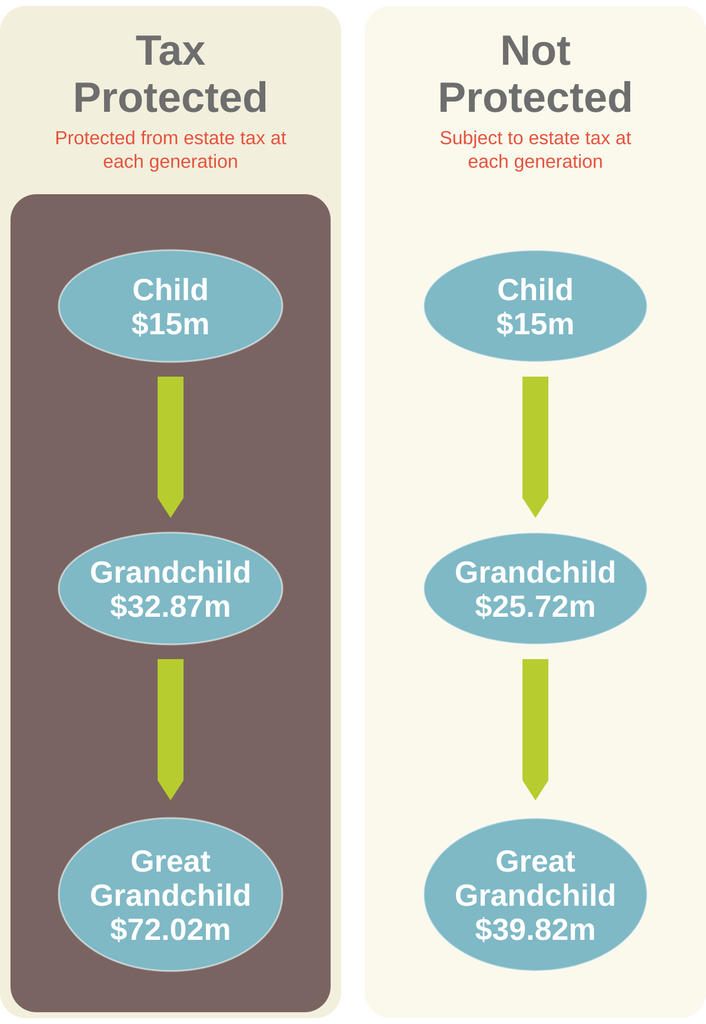
- Assuming net 4% growth rate after payments for income tax, fees and or distributions
- Assuming static $15 million estate taxexclusionamount and static 40% estate tax rate
- Assuming 20 years between each generation
Alternatively, assuming a static $15 million estate tax exclusion, let’s see what happens if the assets are simply passed outright to your child and then your grandchild. At the child’s death in 20 years, we would still have about $32.87 million in assets. However, because the child inherited the assets outright, these assets are subject to estate tax at your child’s death.
Using a simple calculation (without deductions, etc.), a tax bill of about $7.15 million would be owed ($32.87 million gross estate, shielding $15 million with the exclusion, leaving a taxable estate of about $17.87 million* 40%). Thus, the total inheritance for your grandchild becomes $25.72 million.
To complete the thought, after 20 years of 4% net growth during your grandchild’s lifetime, the grandchild’s estate becomes $56.36 million, and after your grandchild’s estate tax is paid, the remainder is approximately $39.82 million.
In short, failing to shield estate tax over two generations costs more than $32 million in taxes and lost growth. And this taxable example doesn’t even contemplate what type of tax issues could arise if the assets were also subject to a GST.
Asset Protection Considerations for Dynasty Trust Planning
For any irrevocable trust for the benefit of another person, there are asset protection opportunities available for trust beneficiaries. This can become even more important for a trust that may last over many decades. Simply speaking, adding what is commonly called a “spendthrift” provision can protect the assets from the beneficiary’s creditors. Just as the assets are not owned by your beneficiary for estate tax purposes, for creditor claims purposes the assets are protected as well.
Generally, there are two common creditors to most people, either a divorcing spouse or someone the beneficiary has injured (like in a car wreck). By having assets in trust, usually these creditors cannot attack the trust assets to satisfy their claim. That said, if the trust makes a distribution to your beneficiary, paying income out to them for example, the protection ends for the distributed assets. Once the assets are received by your beneficiary the assets would then become subject to potential creditors. Given today’s litigious society, coupled with an estimated divorce rate of nearly fifty percent, these asset protection provisions are another reason to consider dynasty trust planning.
How Long Can a Dynasty Trust Last?
Historically the law put a limit on the length of time a trust could last. This limit is known as the Rule Against Perpetuities (“RAP”). It’s a very technical rule, but in its most understandable form the RAP says that any interest must vest, if at all, not later than 21 years after a life in being at the creation of the interest.
There are several technical nuances to the RAP. For the common trust plan, what the RAP generally means in practical terms is that a gift subject to the RAP would have to end within 21 years after the death of the last person living at the time of a grantor’s death. In other words, using our example, if your child and grandchild were alive at your death, the trust would have to end within 21 years after the last of them to die. In short, the trust may have a limited timeframe, albeit capable of being more than 100 years depending on the age of children/grandchildren/great-grandchildren at the time of your death.
Several states have modified or eliminated the RAP as it relates to trusts. Some jurisdictions allow trusts to last for 600 or 1,000 years, while other jurisdictions have eliminated the RAP altogether allowing trusts to last into perpetuity. If you choose to pursue this type of planning, you should work with your estate planning attorney to address these specific issues for your specific situation.
In short, dynasty trusts have the potential to go on for a long time. That means the protection from tax and creditors can continue for a long time as well, potentially allowing for estate and GST tax deferred growth and asset protection for your beneficiaries for many years.
Costs of Having a Dynasty Trust
There are costs to this type of planning. First, given this is more complex planning, you may want to consider engaging a competent estate planning attorney that has created these types of trusts in the past. Because of the complexity you may expect your attorney to charge more to create this type of planning rather than a “traditional” plan that pays outright to beneficiaries.
There are also ongoing costs after you pass away, and the trusts are operating. As an irrevocable trust, the trust will have to file a tax return each year. If the trust retains income, the trust will owe income tax on that amount. If that income is distributed to a beneficiary, that beneficiary will be responsible for paying those taxes.
Other common expenses will include investment costs (such as commissions or management fees) and any other operating costs (real property maintenance and taxes for example). Moreover, given the complexity and longevity of these trusts, having a corporate trustee manage the accounts is often beneficial. Should you select a corporate trustee, they will charge a fee for their services.
These upfront and ongoing costs can vary depending on your selection of the drafting attorney, where you live, who you may name as trustee and other factors. However, these upfront costs generally are not prohibitive. Moreover, ongoing trust administration is often estimated at 1-2%. You should consider whether the amounts of these costs outweigh the potential tax and asset protection benefits of a dynasty trust.
Other Considerations
Some Other Items to Consider Related to Dynasty Trust Planning
For GST protection purposes, only the applicable exclusion amount applies. Currently each of us has a $15 million GST exclusion. Any dollars above the exclusion may become subject to GST as well. You can still stipulate that the excess “non-GST exempt” assets are to be controlled by your trust terms. However, it is a common technique to force the non-GST exempt assets into your child’s taxable estate, consequently paying an estate tax upon the child’s death. This technique is done so that a GST tax is not also imposed at your death on top of any potential estate taxes.
Lack of flexibility: By their nature, dynasty trusts are designed to last for many years and potentially for many generations. However, times and circumstances change. After the creation and funding of the trust the terms of the trust are generally irrevocable. Moreover, you cannot be the trustee of the trust. Because of this you need to consider how much flexibility a trust may require so that the selected trustee can adapt to the evolving world we live in.
Importantly, “portability” does not apply to the GST exclusion amount. Therefore, gifts to “skip” persons using the portable exclusion to limit or eliminate estate/gift taxes may still be subject to GST. More traditional credit shelter/marital trust planning generally allows for more potential assets to be protected via a dynasty trust.1
Remember, these are complex estate techniques that you should only consider after consulting with your legal and tax professionals. But if you are looking to control your legacy and manage generational taxes, consider working with your financial advisor and your tax and legal professionals to explore the dynasty trust as one of many possible solutions to help you meet your legacy goals.
1: For more on portability see the article “Here we go again-Estate taxes have changed” available from your financial advisor
IMPORTANT DISCLOSURES The information provided is based on internal and external sources that are considered reliable; however, the accuracy of this information is not guaranteed. This piece is intended to provide accurate information regarding the subject matter discussed. It is made available with the understanding that Benjamin F. Edwards is not engaged in rendering legal, accounting or tax preparation services. Specific questions on taxes or legal matters as they relate to your individual situation should be directed to your tax or legal professional.
2025-2451 | Exp 09/30/2028